What’s here?
So you want to know about biogas? Well, on this site, we tell you about The Complete Biogas Handbook (see below), about Beginner’s (and now Builder’s!) Biogas Workshops (here), and to offer you solid information (free) about how to build any of four types of small biogas digesters (here). And be sure to look at “Recent Stories” at the bottom of this page... OK?
The main event? TCBH!
The Complete Biogas Handbook— as you can see by the reviews, below— is an excellent, 288 page resource for learning about biogas, “the original natural gas”, and a very simple and useful form of alternative energy. The book is fairly inexpensive: US$32, and for the time being, to support our friends who love biogas, we have decided to offer free shipping to any address in the US! Cheapest shipping to most other countries is around (ouch!) US$40 (approx. €22–€25), and faster but more expensive methods are available; or you can purchase a password-protected PDF copy of the book (cheapest!) for $20.
(Click on
the “Buy it? Click it!” picture
of the book on the upper right of any page on this site (or click
here)
and you will see the various options available for getting a book.)
New! If you prefer to have an electronic copy, we sell a password-protected PDF, lightly personalized with a watermark (your name and email address), for only $20. You can get one of these by clicking this link.
We do not charge for “handling”, whatever that is, so there are no hidden costs.
We’re offering the third edition of The Complete Biogas Handbook, and this site offers five Appendices (of the 19 total) and three Chapters (of the 51) from the book, downloadable for free. (See the table of contents page.)
So How Good Is It, hey?
As recently as late 2006, copies of this book (then out-of-print) were selling on Amazon for up to $140, and more recently on Barnes and Noble for more than $230. Such prices reflected the quality of the resources provided in the book, and encouraged the author and his family to offer the few remaining copies of the second edition for sale. The reaction was a little surprising. All available copies were promptly sold, entirely without advertising or public notification of any kind— therefore encouraging us to revise and republish it.
But perhaps we should not have been surprised. Consider the following excerpts from reviews of the first and second editions of the book:
Reviews by Experts
“Hoo BOY, is it complete! …So lots of the numbers you need are here, and many hard-won tips are shown from often bitter experience.… The book’s main value is in showing how to do things that have been glossed over or ignored in other books, such as burning methane in a gasoline engine. If biogas interests you enough to consider making a generator, this book is your next assignment.”
J. Baldwin, The Next Whole Earth Catalog
“This readable book provides a comprehensive survey of the theory and practice of biogas production. The author discusses the scientific terms used, the substances (such as manure and plant matter) which can produce biogas, and various types of biogas generators.”
Mother Earth News
“House… has written a thorough introduction not only to biogas plants but to the ancillary problems such as gas utilization, engine/generator interfacing, refrigeration, and similar topics.”
Alternative Sources of Energy
“…bringing together material of importance that has hitherto been spread far and wide.”
Steve Smyser, Organic Gardening
“I ordered your book several months ago and have been very excited to find one single source with so much great information in it. It is, without a doubt, the best book out there on small digesters! Bravo, sir! I am currently writing a fact-sheet on micro-digesters and their potential for sustainable farms in the U.S., and your book will be at the top of the recommended reading section.”
Rich Dana, an Energy Specialist working for the National Center for Appropriate Technology
Spontaneous comments from the field
“It Covers Everything”
“My thesis [is] about using solar thermal panels for small-scale anaerobic digestion…. Over the last two years I have become what you might call ‘obsessed’ by anaerobic digestion. The Biogas Handbook was the first piece of literature I read on the subject. After eighteen months of thesis research I continue to use it as my main resource. It is well-organized and covers everything one needs to know for operating a bioreactor. I also enjoy the little anecdotes….”
An email from a reader
“A Little Slurry Spattered”
“Let me say how useful and insightful I have found your book…. It’s a great resource and I tend not to go very far without it— It’s now thoroughly dog-eared and a little slurry splattered!”
From a gentleman in Tanzania creating a business in small-scale digesters
“Thorough and Down-to-Earth”
“I am a student of appropriate technology at […] State University and biogas has been on the radar for some time. I did a research project using biodiesel waste glycerin as a feedstock for biogas with good results. Another of my colleagues built two digesters, one using a passive solar loop from a collector he built, and one using an electric water heater. He is now producing biogas to supplement the heating of his house and recording data for his thesis project.… I wanted to tell you how much I’ve enjoyed the Handbook. It truly is thorough and down-to-earth.”
A student from Asheville, NC
“A Huge Help to Me”
“For a long time now I have wanted to thank you for your excellent book. I am developing a regional-scale food waste (and other organic waste) digester…. Your book has been a huge help to me in the development of this project. I appreciate the way you write to be understood by everyone, and I also appreciate that you cover all aspects of digestion from feedstocks to design variations.
“So, thank you. Your efforts in disseminating knowledge about anaerobic digestion are resulting in increased sustainability in my community.”
From a Program Analyst for a county Waste Management Authority— a professional in the field
“…the most helpful biogas… book available…”
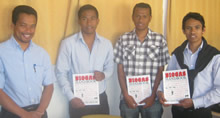
“Our team finds your book the most helpful biogas and biodigestion book available, and we had already purchased a copy for everyone on our team domestically. That’s why we naturally decided to use your book as the textbook for the students we’re working with in Madagascar [see right]. Working with you was incredibly helpful…. We are incredibly satisfied….”
Merry from Vort Port International, an NGO working to assist the poor.
“This Bible of Biogas”
“I have really enjoyed reading your book. Apart from being very informative about the topic with a very deep coverage, it is very easy to understand and easy to find what you are looking for. I myself have done a lot of “research” into the literature available about biogas and as you point out it is very difficult to really compare one study to another due to lack of standardization. I also very much like your distance from the whole topic without losing depth. It is very funny to read and easy to understand.
“I am ordering 3 more copies for my engineers to use. Hopefully we can contribute to forthcoming editions of this bible of biogas.”
A business development expert creating alternative energy projects and biogas plants worldwide
Sample Excerpts
Almost 30 substrates— digestible plant wastes, manure and so on— are discussed and known research about them is presented in considerable detail:
“Buswell [says]… ‘the present estimate is that from 5 to 10 cubic feet of gas can be obtained per pound of cornstalks, and that the rate of production will be from ½ to 1 cubic foot of gas per day per cubic foot of tank volume. Taking the lower figure, a ton of cornstalks would furnish gas for 400 people for one day, allowing 25 cubic feet per capita per day. From the data given by Weber for yields from regions where 30 percent of the land is planted to corn, an area with an 8-mile radius will produce enough cornstalks to supply a city of 80,000 inhabitants continuously. In other words, the cornstalks from one acre will produce the gas for one person for a year.’”
Chapter 17: Plant Substrates, pg. 74 [Emphasis added]
“…Due to the fact that the pig is such a useful animal, providing bacon, sausage, ham, and pickled pig’s knuckles, there are a great many pigs in a great many countries. Biogas research has occurred using pig manure as a substrate because of the economic importance and the large population of pigs. Therefore, information specifically about pig manure is available whereas information about llamas, peacocks, gerbils, elephants, gnus, large herds of wild voles (and the like) is totally absent.”
Chapter 16: Manure Substrates, pg. 69 [Note the two references/links to new work, above.]
This book offers extensive information about all aspects of biogas production, and details some small-scale designs. For example, the design for a simple, low-cost test generator is provided, and other novel design ideas based in solid research are offered:
“…Ghosh, Conrad, and Klass (1975) report that in what they referred to as a ‘two phase digestion system,’ the second phase (or methane module in our terms) produced 8.9 volumes of biogas, per unit volume of generator per day. They further report that the gas was 70% methane. If you achieve this kind of production from the two-barrel methane module of the proposed hybrid generator, it would produce about 3,800 liters of biogas per day, or nearly 2,700 liters of methane per day (respectively, 135 and 95 cubic feet). In terms of the energy in that much methane, 2.16 x 10⁴ Calories, or 8.5 x 10⁴ BTU. That’s no small potatoes from two little 55-gallon drums…”
Chapter 49: Hybrid Generator, pg. 206
“…If you are considering using the test generator for its intended purpose— testing— then fill up a barrel with your substrate, arrange to keep it warm, and try to establish a culture of methane-producing bacteria. The procedure is covered generally in Chapter 31: Startup, p. 168, and cultures are discussed in Chapter 30: Cultures, p. 165.”
Chapter 47: Test Generator, pg. 199
Information not easily found elsewhere is clearly presented in this book. For example, the small scale use of human wastes to produce biogas is thoroughly examined:
“The American toilet gives us an end product which is neither suitable for use in a small-scale generator, nor safe to dispose of into the environment. Not only will it fail to give us biogas, but it kills aquatic life and spreads disease.
“One way out of this dilemma is to ignore the toilet and produce biogas using only kitchen wastes. Therefore access to the waste water from an existing sink (via modifications under the sink), or the addition of a special sink, used only for kitchen garbage, may be a better answer. (A garbage disposal, if carefully used to avoid introduction of excess water, is a definite plus.) Besides, for one or two people, the added biogas from toilet wastes will probably not amount to a great deal.”
“‘But,’ you may protest, ‘I want to make biogas from my food ’ (i.e., after it has been eaten). So be it. But not with an average toilet hooked into the system, or only with a great deal of well-shredded dry substrate in the bargain, if an average toilet is used.
“Assuming you use your toilet, you will need a minimum of 200 liters of generator volume per flush per day (assumes a 10-day HRT), and you should add between 1 and 1.8 kilograms (2.2 to 4 pounds; TS weight) of well-shredded substrate materials (such as leaves or kitchen wastes) per flush— if you can.
“In other words, minimum generator volume of ten times the toilet waste volume per day, plus added materials to bring the total solids up to between 5% and 9%…”
Chapter 50: Home Wastes Generator, pg. 209
“…One adult on an ordinary diet will produce from 100 to 250 grams of feces per day. On a vegetable diet, an adult will produce from 300 to 400 grams per day. (Respectively, 0.22 to 0.55, and 0.66 to 0.88 pounds per day.) Feces are usually neutral to slightly alkaline in pH, 24% to 27% TS (dry weight), with a C/N of 6 to 10, nitrogen 4% to 6% of TS, VS is 85% of TS. Normal values for urine are 1 to 1.6 liters volume per day, average pH 6.0, 4% to 6% TS, with a C/N of 0.8, nitrogen 15% to 18% of TS, VS is 72% of TS. (That’s 1.06 to 1.69 quarts volume produced daily.) Every liter of urine weighs about 1,020 grams. Every quart of urine weighs about 2.9 pounds.”
Chapter 16: Manure Substrates, pg. 68
In sum…
…There is much, much more in this book, in its 51 chapters and 21 appendices. It also has 90 figures and almost 60 tables, an index and two tables of contents (one brief, one comprehensive) for ease of finding items. As well, it contains information about growing algae for producing biogas (Chapter 18), and some possibilities regarding biohydrogen (Appendix 2), which we are offering to you as some of the free Chapters and Appendices available on this web site.
See the brief Table of Contents, and see the complete list of free downloadable Chapters and Appendices, here…